
Why Your Dog's Behavior Won't Change (And It Has Nothing To Do With Your Dog)
The psychology of belief, the science of persistence, and what's really standing between you and a dog who actually listens.


There’s a famous optical illusion called the Coffer Illusion. Two people look at the exact same image. One sees circles. One sees squares. Neither is wrong. Neither is lying. Their brains, shaped by completely different life experiences, are filtering the same raw information and delivering two completely different realities.
That’s not a quirk of visual processing. That’s just Tuesday. That’s how all of us move through the world, all the time, about everything.

Nir Eyal, the bestselling author of Hooked and Indistractable, opens his new book Beyond Belief with a claim that should stop you cold: human beings never perceive reality as it truly is. Our brains run everything through a pre-existing filter of beliefs and expectations, and the kicker? We almost never notice it happening. And then he offers this:
“The crucial question to ask about a belief is whether it is useful, not whether it is true.”
Sit with that for a second. Because I think it changes everything, especially if you’ve ever found yourself stuck with your dog’s behavior and quietly started to wonder whether things can actually change.
I teach at a university. I talk about evidence-based training, behavior science, peer reviewed research. And I want to be honest with you about something that people in my field rarely admit out loud: those aren’t facts. Those are beliefs I have faith in. I have drawn conclusions, alongside other professionals and accredited organizations, about what we believe to be the most effective and ethical way to work with dogs. The research informs that. It doesn’t prove it in some absolute, unquestionable sense. Science is a method, not a verdict.
Here’s what’s funny: open any corner of the dog training internet and you’ll find three pages, each presenting themselves as settled fact. Page one: dogs learn best through positive reinforcement. Page two: dogs are miniature wolves trying to dominate your home and you need to become the alpha. Page three: training is intrusive, let dogs be wild and free. Three pages. Three sets of “facts.” And you’re going to pick the one that confirms what you already suspected. Don’t be embarrassed. That’s not a character flaw, that’s just your brain doing exactly what brains do. The more interesting question is: which belief will actually help you?
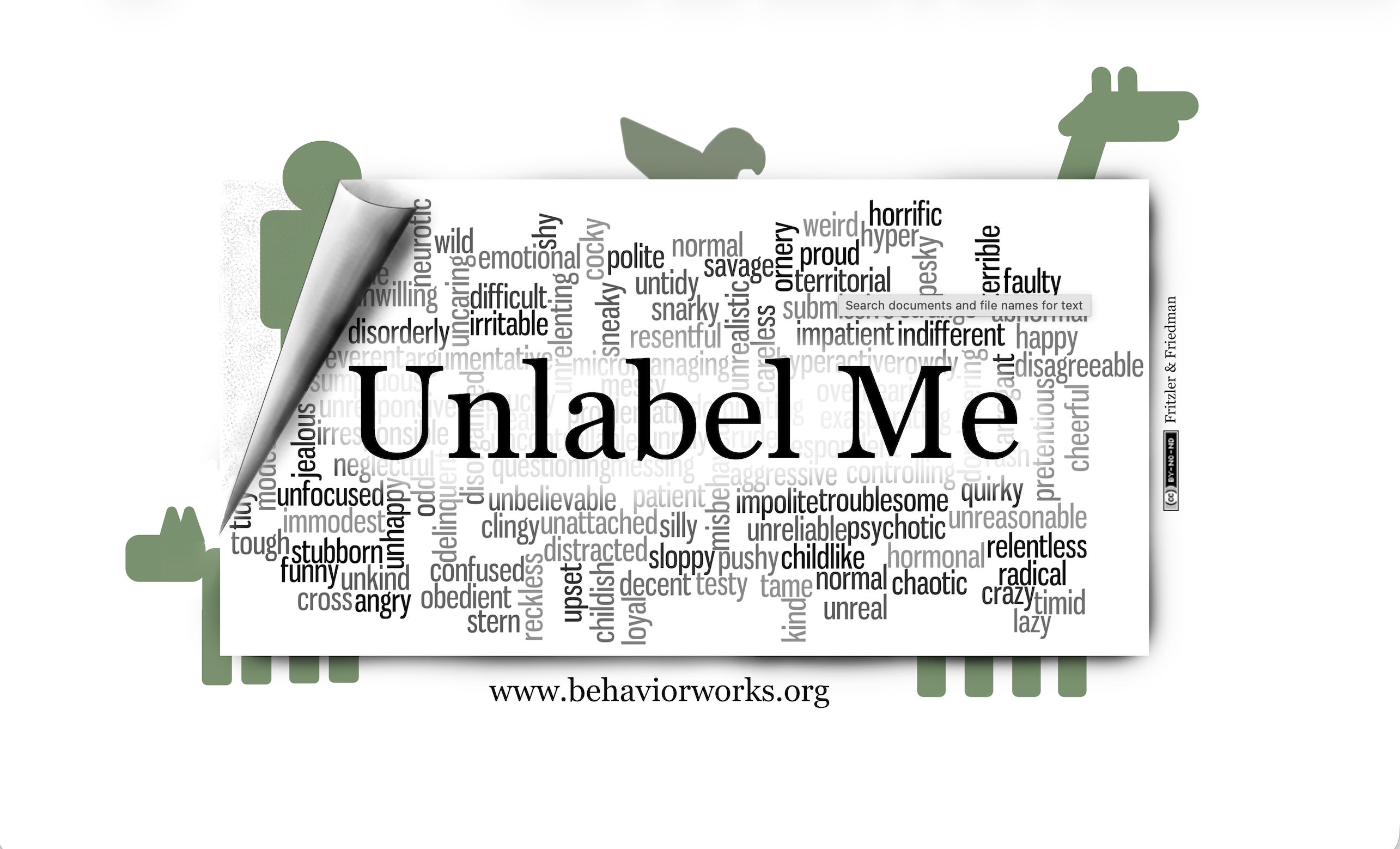
Because here’s where it gets practical. A client comes to me and within the first five minutes of our conversation, I hear something like: “He’s just reactive. It’s his breed. She’s always been anxious. He’s stubborn.” These words sound like observations. They’re not. They’re stories. And stories have a sneaky way of becoming ceilings.
Behavior analyst Susan Friedman puts it in a way I keep coming back to: “The most important thing is to connect to the answer: what is behavior for? Behavior is for operating on the environment.” Behavior is not personality. Behavior is not identity. It is a tool your dog is using, right now, in this context, with this history, to interact with the world around them. When you call your dog “reactive,” you’ve named a pattern. Fine. But the moment you start treating that pattern as a fixed trait, something baked into who they are, you’ve stopped seeing a behavior that can change and started seeing a dog that can’t. That’s not a description. That’s a verdict. And you handed it down without a trial.
Which brings me to a study that I think about more than I probably should. And before I get into it, I want to say something I mean genuinely: the history of behavioral science is inseparable from the history of animal experimentation, and a lot of that history is brutal. The studies that gave us our deepest understanding of learning, persistence, fear, and resilience were conducted on animals who had no choice and no advocate. That’s worth sitting with. We owe an enormous debt to lives that were taken, often terribly, in the name of understanding. The least we can do is hold that truth alongside the knowledge those studies produced, and let it inform how we think about and treat the animals in our care today.
With that said: in the 1950s, a biologist named Curt Richter put wild rats into a cylinder of water with no way to climb out. Just swimming in circles. The average rat gave up after about 15 minutes. Then he changed one variable. Right around the 15 minute mark, when the rat was exhausted and starting to sink, he reached in, pulled it out, dried it off, let it rest briefly, and put it back in. That’s it. That’s the whole intervention. How long did those rats swim? Sixty hours. A rat that would have drowned in 15 minutes swam for sixty hours because it had learned one thing: rescue is possible. That’s not a physical change. That’s a belief. And that belief rewrote what the rat was capable of entirely.
Studies like this one are as disturbing as they are illuminating. They are also, undeniably some of the catalysts that changed the way we think and talk about behavior across every mammalian species, including our own. The science that came out of those labs, as uncomfortable as its origins are, is part of why we now understand that behavior is not a fixed destiny. It is a living, responsive thing. Which, if you’re reading this because you’re struggling with your dog, is actually the most hopeful thing I can tell you.
The only meaningful difference between the rat that drowned and the rat that swam for sixty hours wasn’t strength, or genetics, or training history. It was hope. It was the persistent, embodied sense that effort is not pointless. And I’d argue that same variable, more than your trainer’s credentials, more than your budget, more than the specific method you’re using, is what will determine whether your dog’s behavior actually changes.
Which is why about 90% of my job has nothing to do with dogs. It’s motivating people to believe, genuinely believe, that change is possible. Then giving them the skills to get started. Then finding some way to keep them going when it gets hard and slow and boring, which it always does. The dogs are almost always ready. Dogs are astonishingly willing to change when approached correctly. It’s the humans who tap out. Not because they don’t love their dogs, but because somewhere along the way they started believing that the behavior is the dog. And once you believe that, persistence feels pointless.

I meet people every day who want to do serious behavior modification work: fear, reactivity, aggression. And their dog can’t hold a sit for three seconds. Has never walked on a loose leash. Doesn’t reliably come when called. We haven’t built the foundation, and we’re already trying to renovate the top floor. That’s not a dog problem. That’s a belief problem. Somewhere, the story became: this is just who my dog is. And the work quietly stopped.
So I’ll leave you with the question I keep coming back to: what story are you telling about your dog’s behavior? Because you are not a neutral observer. None of us are. You are, like every human who has ever lived, seeing your dog through the filter of every experience, frustration, hope, and assumption you’ve ever accumulated. The question isn’t whether your perception is filtered. It is. The question is whether the filter is useful. Whether the story you’re telling is helping you both move forward, or whether it’s just a comfortable explanation for why things can’t change.
Behavior is not who your dog is. It is what your dog does. And what any creature does, including you, is always, on some level, a response to what they’ve learned is possible.
Give them a reason to keep swimming.
Sources & Further Reading
Check out Susan Friedmans amazing site and download your own behavior toolkit or read some of her amazing and free resources on all things behavior for any species. https://behaviorworks.org/htm/downloads_toolkit.html
The rat swimming study referenced in this piece: Bruner, C.A., & Vargas, I. (1994). The activity of rats in a swimming situation as a function of water temperature. Physiology & Behavior, 55(1), 21–28. https://doi.org/10.1016/0031-9384(94)90004-3 — PubMed
The original forced swim experiments were conducted by Curt Richter in the 1950s. This 1994 paper by Bruner and Vargas extends that line of inquiry, examining how environmental variables affect persistence and activity in the same swimming paradigm. Worth reading if you want to go deeper on the science behind what conditions shape how long an animal keeps going.
A note on sourcing: the Richter origin story, the 1950s “hope” experiment with the 60 hour result, is widely cited in popular psychology but the primary source is difficult to verify directly. The Bruner and Vargas paper is the most rigorous peer reviewed work in this lineage I’d point readers toward. If you have a cleaner citation for the original Richter data, I’d love to see it. That’s the kind of thing worth getting right.